Knowledge
Check the Psychomatrix working numbers
Calculate the Psychomatrix by hand: four working numbers, a full example, and rules for days 1–9, negative intermediate values, and zeros.
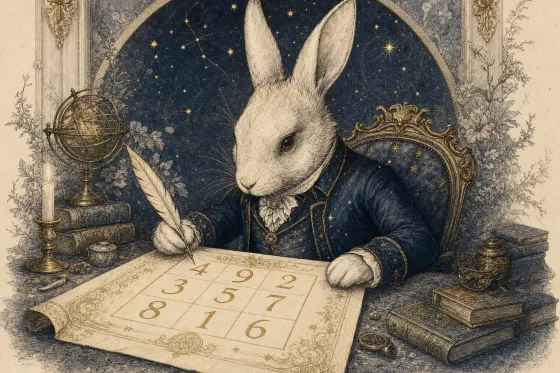
Do two calculators show different grids for the same birth date? Start by comparing A, B, C, and D. These four working numbers show which convention was used. Here you can check the NOVA calculation step by step.
A and B: date total and one digit sum
Write the date with the day, month, and full year. For 15.03.1990, add 1 + 5 + 0 + 3 + 1 + 9 + 9 + 0 = 28. That is A. For B, add the digits of A once: 2 + 8 = 10.
Here, B remains 10. If you added 1 + 0 again, you would be using a different convention. A master number rule for the life path number is no reason to treat working numbers differently either: the Psychomatrix is a separate calculation.
C and D: the first digit of the birth day
For a birth day of 15, the first digit is 1. NOVA subtracts twice that number from A and takes the absolute value: C = |28 − 2 × 1| = 26. D is the one-time digit sum of C: 2 + 6 = 8.
So the full working numbers for this date are 28, 10, 26, and 8. The month and year contribute to A; for the subtraction in C, however, the first digit of the day is used.
What to do with a single-digit birth day
A birth day on the 9th is written as 09 in the full date. For the first digit of the day, NOVA still uses 9. The leading zero is a formatting choice, not the value used in the subtraction.
For 09.01.2000, A = 12 and B = 3. This gives C = |12 − 2 × 9| = 6 and D = 6. The intermediate value before taking the absolute value would be −6. NOVA counts the digits of the absolute value; a minus sign is not counted as a digit.
From the calculation to the grid
Combine the digits from the date and from A, B, C, and D. For 15.03.1990, these are the date digits plus 2, 8, 1, 0, 2, 6, and 8. The digit 1 appears three times, 2 twice, 3 once, 5 once, 6 once, 8 twice, and 9 twice. The 4 and 7 fields remain empty.
Zeros do not affect the totals and do not have a field of their own. A higher count is first of all a mathematical frequency, not a statement about a better or worse personality.
Checklist for different results
- Were the day and month swapped?
- Were all four year digits used?
- Was B or D reduced more than once?
- For 09, was 0 used instead of 9?
- How was a negative intermediate result handled?
- Were the working numbers counted as well?
Compare with the NOVA calculator · Understand the fields and lines · More calculation conventions.
Is B reduced until only one digit remains? +
Not at NOVA. B is the one-time digit sum of A. So when A = 28, B = 10.
Which day digit is used for 09? +
NOVA uses 9. For 15, the calculation uses the first digit, 1.
What happens to negative intermediate values? +
For working number C, NOVA uses the absolute value. So −6 becomes 6; then the one-time digit sum is calculated for D.