Knowledge
Understanding Your Psychomatrix: Start with One Field
What do the nine fields and lines in your Psychomatrix mean? Read your grid with examples and distinguish numbers from interpretations.
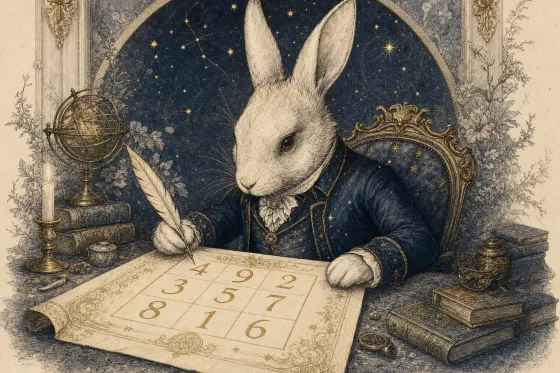
Your matrix is in front of you: some fields are filled more than once, while others are empty. You don’t need to read all nine interpretations at once. Start with one digit and first note what was actually calculated. Then you can see whether the traditional interpretation offers a helpful question.
Count first, then interpret
111 means that 1 appears three times. It isn’t a score of three points, nor a new number, 111, that needs to be reduced. The repetitions come from the digits in your birth date and the four working numbers. An empty spot means zero occurrences.
The associated themes—such as initiative for 1 or responsibility for 8—are a numerological interpretation. They don’t follow automatically from the mathematics. You can check the count; whether the description fits you is for you to decide based on your experience.
The nine fields as questions
- 1, Initiative: When do you like to take the first step?
- 2, Energy: Which activities make you feel energized?
- 3, Learning: What makes you curious?
- 4, Foundation: Which habits give your daily life stability?
- 5, Thinking: How do you connect facts with gut feelings?
- 6, Practical action: What would you like to finish?
- 7, Possibilities: How do you deal with opportunities and chance events?
- 8, Responsibility: Which commitments fit within your own limits?
- 9, Memory: Which experiences help you today?
These questions are invitations to reflect. A missing 4 can’t indicate an illness, and a full 9 isn’t an intelligence test.
An example with three ones
In the example 15.03.1990, 1 appears three times. The traditional association directs your attention to initiative. Instead of “You’re always assertive,” you might ask yourself: In which areas do I like to make my own decisions? When would I like support? Two specific situations can tell you more than a general label.
You may find that a description doesn’t resonate with you. If so, you don’t need to make the number fit or judge yourself by it. Your personal experience can contradict an interpretation.
What the lines add
A line adds together the counts in its three fields. For 111, 22, and 3, the sum of line 1–2–3 is therefore 3 + 2 + 1 = 6. You add the occurrences, not the values 1 + 2 + 3 or the number 111.
Rows, columns, and diagonals are traditionally associated with additional themes. In the NOVA view, the digits involved in each line are named. Read a line only once you understand its individual fields; a high value doesn’t automatically make it “better.”
How to use your result
Write down a question that speaks to you and find an example from your everyday life. If you’d like to change a habit, choose a small step that makes sense to you. You don’t need to make up for any “missing energy.”
Calculate your Psychomatrix or take another look · Understand empty fields in more detail · Methods and limitations.
Are more digits in a field better? +
No. The number first describes a frequency. More occurrences don’t mean greater personal worth or a proven talent.
What does the sum of a line mean? +
It’s the sum of the digit counts in the three fields that make up the line. Three ones, two twos, and one three add up to a line total of 6.
Do I have to see myself in the interpretation? +
No. A numerological description is an invitation to reflect. Your experiences may differ.